“The spread of computers and the Internet will put jobs in two categories. People who tell computers what to do, and people who are told by computers what to do.”
– Marc Andreessen, Entrepreneur, inventor of Netscape and member of the World Wide Web Hall of Fame.
At Olga we aim to give our children every opportunity to be in the first category.
Intent
Through the teaching of computing and online safety at Olga, children are encouraged to safely use computational thinking and creativity to understand and change the world. The children learn new computing and online safety specific knowledge and skills, and apply existing ones from a variety of disciplines, in particular mathematics, science and design and technology – all subjects that computing has deep links with. The knowledge and skills learned in computing are also applied across the entire curriculum.
Computing is split into three strands:
- Computer science (programming or coding, and problem solving)
- Information Technology (for example, using spreadsheets, creating presentations and manipulating graphics)
- Digital Literacy (encompassing online safety and teaching pupils how to select the most appropriate digital content).
Implementation
EYFS
In the Early Years, technology is taught and used across the whole curriculum. Children recognise that a range of technology is used in places such as homes and schools and that online safety is important. The children are helped to be curious about technology in real world contexts through role-play and natural discussions. They learn to select and use technology for particular purposes across various areas of learning. A wide range of digital technologies (for example, iPads and programmable robots to support early coding skills) allow the children to represent their own ideas, thoughts and feelings -often collaboratively- as well as providing them with new ways to communicate and share their ideas. Within the EYFS we encourage parents to be involved in their child’s learning journey by using digital technology to record and share their child’s learning at home through photographs and videos taken on phone and iPads. We ensure there is a careful balance between encouraging parents to use digital technology with their children and understanding that there is a need to limit screen time so that its use is purposeful and meaningful. They develop skills such as investigating, evaluating, using commands and simple algorithms.
Years 1-6
In years 1-6 the core of computing is computer science; pupils are taught principles of information and computation, how digital systems work, and how to put this knowledge to use through programming. Building on this knowledge and understanding, pupils are equipped to use information technology to create programs, systems and a range of content. Computing also ensures that pupils become digitally literate –able to use, and express themselves and develop their ideas through information and communication technology- at a suitable level for the future workplace and as active participants in a digital world.
We follow the Teach Computing Curriculum.
Teach Computing
Teach Computing has been fully adapted so that it fits with our context in terms of overall curriculum aims and our equipment and software. It ensures that children receive the breadth of learning required by the National Curriculum, and that skills and knowledge are built on over time.
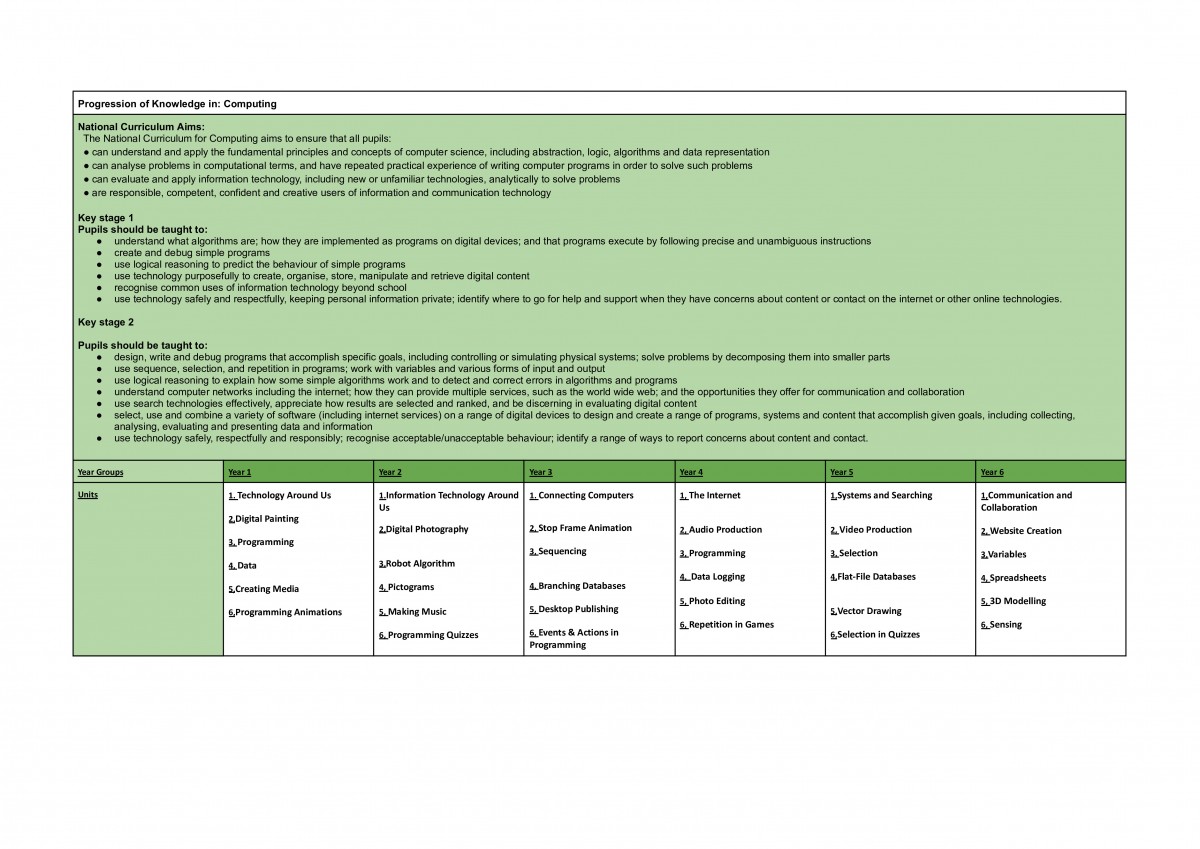
Units for each year group cover:
- Computing System and Networks
- Creating Media (two half term long units)
- Programming (two half term long units)
- Data and Information
- Online Safety
These things are taught through a range of projects that mean the children are encouraged to learn computing in a ‘real world’ joined up way, as opposed to learning discrete skills in isolation.
Please note we have a separate page on our website that details our approach to Online Safety.